
Vax2Muc research highlights: From correlates of protection to spatial mapping
The Vax2Muc consortium aims to develop next-generation vaccines against diseases caused by mucosal pathogens colonising the gastrointestinal tract. More concretely, the goal of this interdisciplinary research collaboration is to create, as a proof-of-concept, a prophylactic H. pylori vaccine candidate that will be evaluated in a phase I clinical trial.
Exciting findings are emerging from the ongoing research done by the international and multidisciplinary consortium, and researchers are busy presenting them at conferences. In the third edition of Vax2Muc research highlights, we feature two posters and one talk presented in the first half of 2026 by two Vax2Muc researchers: Freddy Dehesa from the Institute of Agrifood Research and Technology’s Animal Health Research Center (IRTA), and Gitte Erbs from the Statens Serum Institut (SSI).
Conference: Vaccinology: A New Era in Immune-Driven Vaccine Design, Killarney, Ireland
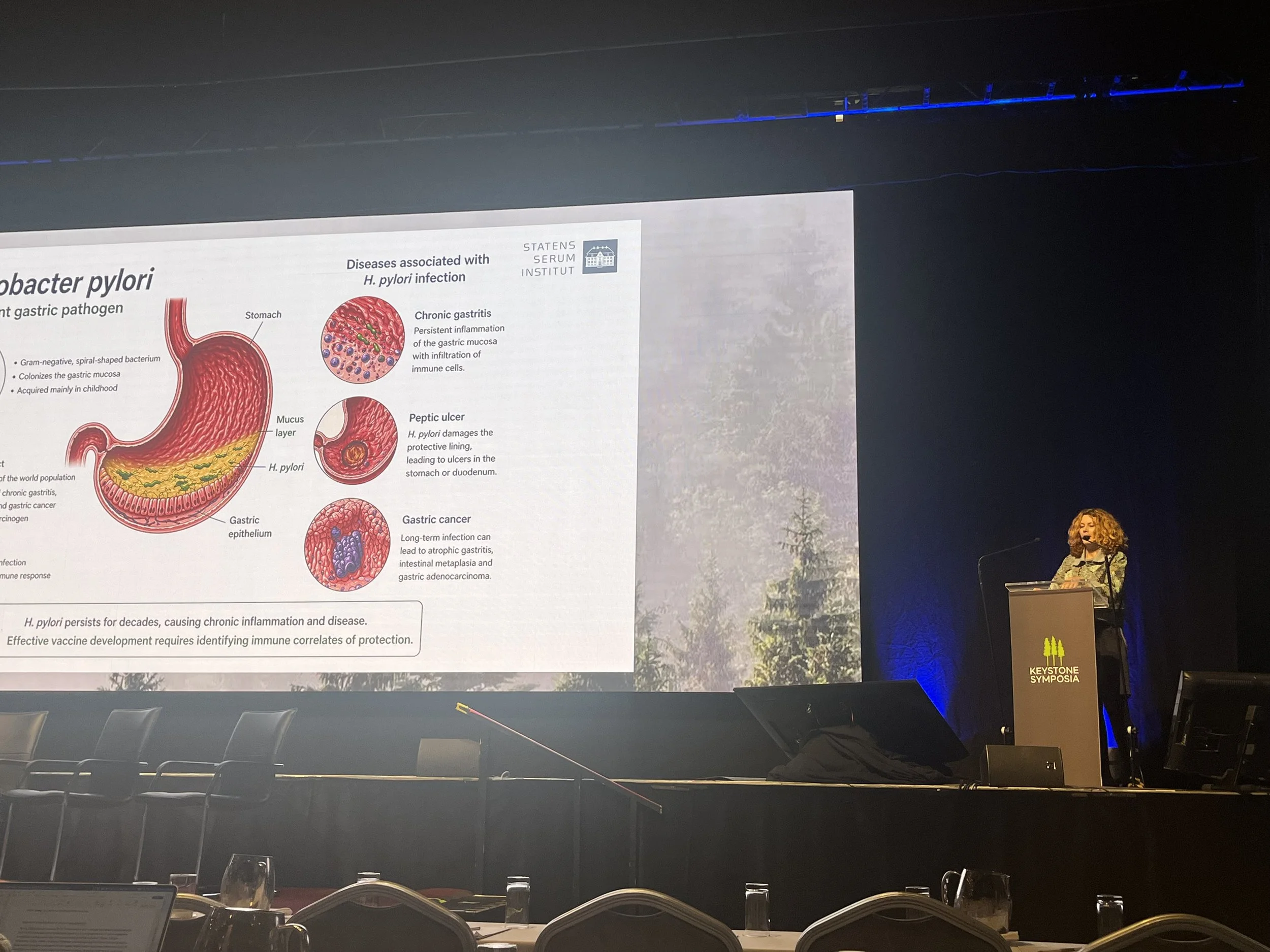
Talk title: Identification of immunological correlates of protection (CoP) in the Helicobacter pylori mouse challenge model
Presenter: Gitte Erbs, Statens Serum Institut (SSI)
What was the talk about?
This presentation introduced the ongoing research aiming to identify immunological correlates of protection in response to an H. pylori infection.
Correlates of protection are measurable signs that a person is protected against becoming infected or developing disease.
Scientists tested different immunisation methods in mice with the goal of identifying markers that indicate protection from the bacteria.
The findings from this study will serve as a foundation for future vaccine development.
How does this work fit into the ongoing Vax2Muc research?
Identification of correlates of protection will guide Vax2Muc mucosal vaccine research and the identification of an H. pylori vaccine candidate to be evaluated in a future clinical trial.
Conference: European Symposium of Porcine Health Management (ESPHM 2026), Florence, Italy.
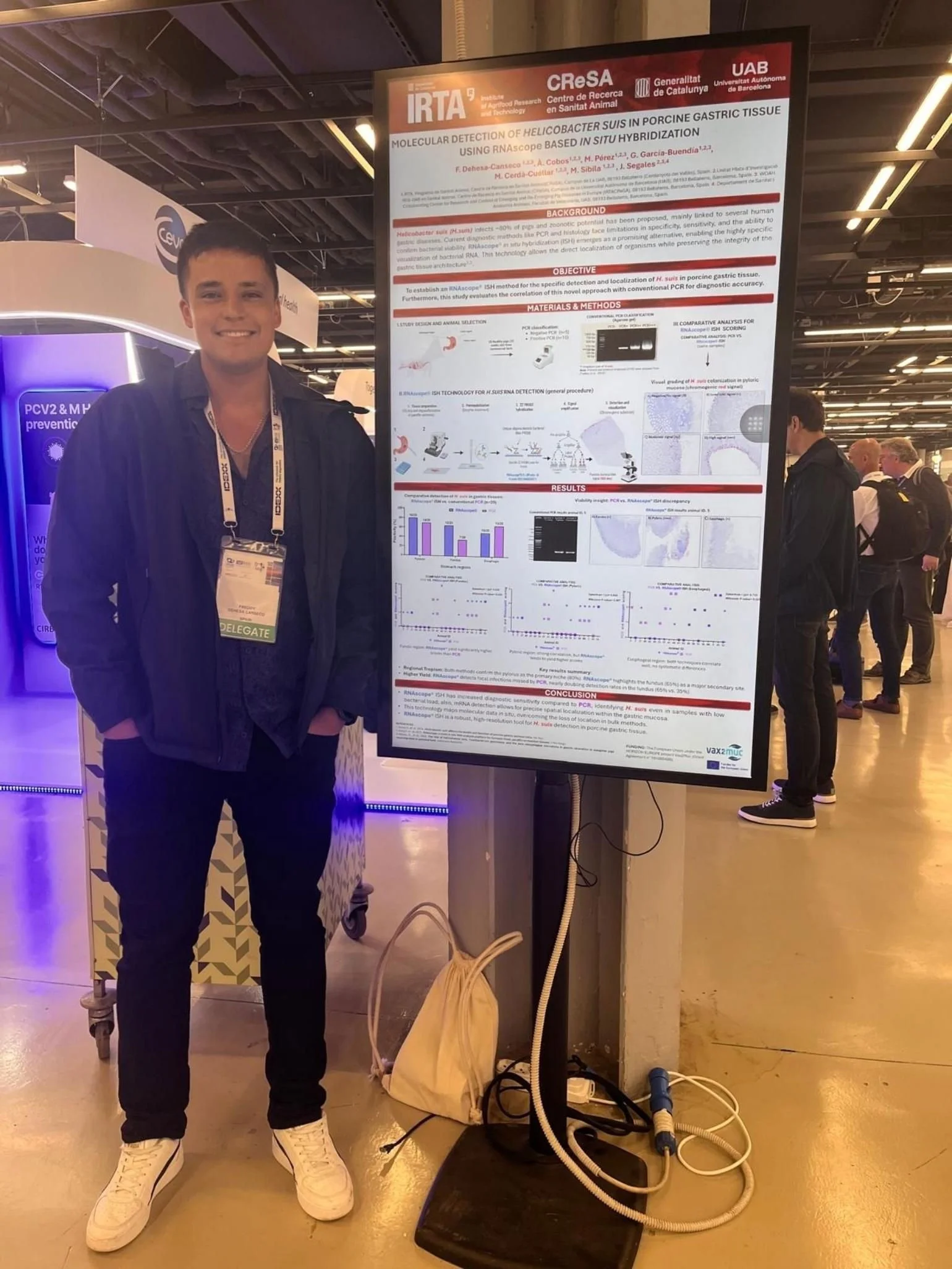
Poster title: Molecular detection of Helicobacter suis in porcine gastric tissue using RNAscope-based in situ hybridisation
Presenter: Freddy Dehesa-Canseco, Institute of Agrifood Research and Technology’s Animal Health Research Center (IRTA)
What is the poster about?
Helicobacter suis is a bacterium that infects approximately 80% of pigs and is linked to various human gastric diseases. This poster presents a study on the molecular detection of H. suis in pig stomachs using RNAscope®-based in situ hybridisation (ISH).
RNAscope®-based in situ hybridisation is a molecular detection technology designed for the highly specific visualisation and localisation of bacterial RNA within tissue samples.
The researchers aimed to establish an RNAscope®-based ISH method to detect and localise H. suis in pig stomachs and compare it with the diagnostic accuracy of the PCR tests.
What are the main findings?
RNAscope® was more sensitive than PCR, detecting H. suis in samples with low bacterial load that PCR missed. Unlike PCR, which does not provide spatial information, RNAscope® enables the precise spatial localisation of bacteria within the gastric mucosa while preserving tissue integrity.
The authors conclude that RNAscope®-based ISH is a robust, high-resolution tool for detecting H. suis.
How do these findings fit into the ongoing Vax2Muc research?
The development of a reliable method to detect and localise H. suis in porcine gastric tissue is an important step for the Vax2Muc research programme. As H. suis is highly prevalent in pigs and can complicate experimental H. pylori infection studies, being able to accurately identify its presence and distribution in the stomach is essential for characterising the animals used in preclinical research.
By combining RNAscope®-based ISH with conventional PCR, the researchers were able not only to improve the detection of H. suis, particularly in samples with a low bacterial load, but also to determine its precise location within the gastric tissue. This information will help Vax2Muc researchers better understand the presence and distribution of H. suis in pigs and assess its potential impact when developing and evaluating the H. pylori infection model and future vaccine candidates.
Interested in learning more? You can download the poster here.
If you’d like to explore Vax2Muc findings further, take a look at the previous two editions of the Vax2Muc research highlights: